A unification of permutation patterns related to Schubert varieties
Pure Mathematics and Applications, Volume 22 (2011), Issue No. 2
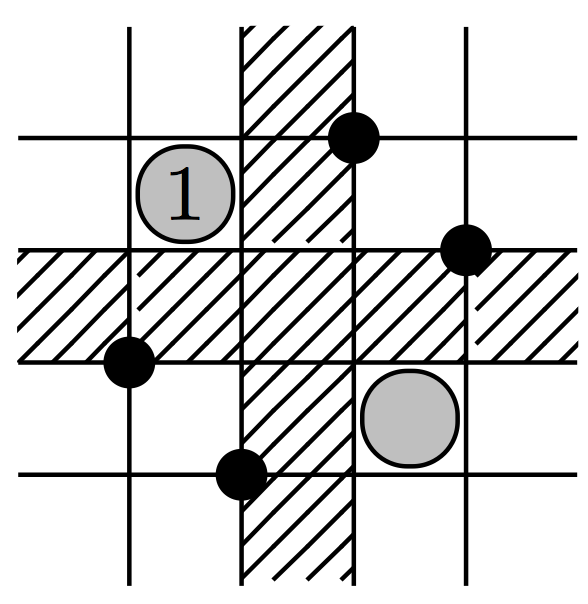 We obtain new connections between permutation patterns and singularities of
Schubert varieties, by giving a new characterization of Gorenstein varieties in
terms of so called bivincular patterns. These are generalizations of classical
patterns where conditions are placed on the location of an occurrence in a
permutation, as well as on the values in the occurrence. This clarifies what
happens when the requirement of smoothness is weakened to factoriality and
further to Gorensteinness, extending work of Bousquet-Melou and Butler (2007),
and Woo and Yong (2006). We also show how mesh patterns, introduced by Branden
and Claesson (2011), subsume many other types of patterns and define an
extension of them called marked mesh patterns. We use these new patterns to
further simplify the description of Gorenstein Schubert varieties and give a
new description of Schubert varieties that are defined by inclusions,
introduced by Gasharov and Reiner (2002). We also give a description of
123-hexagon avoiding permutations, introduced by Billey and Warrington (2001),
Dumont permutations and cycles in terms of marked mesh patterns.
We obtain new connections between permutation patterns and singularities of
Schubert varieties, by giving a new characterization of Gorenstein varieties in
terms of so called bivincular patterns. These are generalizations of classical
patterns where conditions are placed on the location of an occurrence in a
permutation, as well as on the values in the occurrence. This clarifies what
happens when the requirement of smoothness is weakened to factoriality and
further to Gorensteinness, extending work of Bousquet-Melou and Butler (2007),
and Woo and Yong (2006). We also show how mesh patterns, introduced by Branden
and Claesson (2011), subsume many other types of patterns and define an
extension of them called marked mesh patterns. We use these new patterns to
further simplify the description of Gorenstein Schubert varieties and give a
new description of Schubert varieties that are defined by inclusions,
introduced by Gasharov and Reiner (2002). We also give a description of
123-hexagon avoiding permutations, introduced by Billey and Warrington (2001),
Dumont permutations and cycles in terms of marked mesh patterns.
Download the paper
Presentations
Additional material
Later work (last updated 2 October 2026)
- S. Kitaev and J. Remmel, Quadrant marked mesh patterns, J. Integer Seq. 15 (2012). Begins the systematic study of how quadrant marked mesh patterns, a special case of the marked mesh patterns introduced here, are distributed over permutations.
- S. Kitaev, J. Remmel and M. Tiefenbruck, Quadrant marked mesh patterns in 132-avoiding permutations, Pure Math. Appl. 23 (2012). The same distributions over 132-avoiding permutations, continued in parts II and III (Integers 15, 2015).
- S. Kitaev and J. Remmel, Quadrant marked mesh patterns in alternating permutations, Sém. Lothar. Combin. 68 (2012). The same distributions over alternating permutations, continued in part II (J. Comb. 4, 2013).
- H. Úlfarsson and A. Woo, Which Schubert varieties are local complete intersections?, Proc. Lond. Math. Soc. 107 (2013). Characterizes the Schubert varieties that are local complete intersections by pattern avoidance; the proof translates the avoidance conditions into the marked mesh patterns introduced here.
- H. Abe and S. Billey, Consequences of the Lakshmibai–Sandhya theorem: the ubiquity of permutation patterns in Schubert calculus and related geometry, Adv. Stud. Pure Math. 71 (2016). A survey of pattern characterizations in Schubert calculus; it presents this paper’s descriptions, by marked mesh patterns, of the permutations indexing smooth, factorial, Gorenstein and defined-by-inclusions Schubert varieties.
- D. Qiu and J. Remmel, Quadrant marked mesh patterns in 123-avoiding permutations, Discrete Math. Theor. Comput. Sci. 19 (2017). The distributions of quadrant marked mesh patterns over 123-avoiding permutations.
- S. Thamrongpairoj and J. Remmel, Positional marked patterns in permutations, Discrete Math. Theor. Comput. Sci. 24 (2022). Introduces positional marked patterns, permutation statistics in the line of the marked mesh patterns introduced here.
- All citing papers on Google Scholar (55)