Coincidence and Wilf-classification
Christian, Anders, Bjarki, Isak, Ingibjorg, Steinunn, Murray, Bridget, Tomas, Henning and Lína
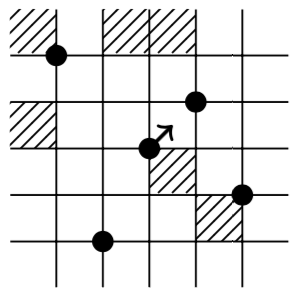 Two patterns are coincident if they are avoided by the same permutations, and Wilf-equivalent if they are avoided by the same number of permutations of each length. We study general rules that tell when patterns, or sets of patterns, are coincident or Wilf-equivalent. For mesh patterns, the Shading Lemma gives sufficient conditions for when a box can be added to the mesh of a pattern without changing the permutations that avoid it. With it and other rules, the mesh patterns of length 2 fall into at most 56 Wilf-classes. Later we gave necessary conditions for coincidence, such as having the same enclosed diagonals, and rules for coincidence among the permutations that avoid a longer classical pattern, with which we Wilf-classified the mesh patterns of length 2 inside the 231-avoiding permutations. The notion of a force on a pattern then completed the coincidence classification of mesh patterns up to length 3, and it can also be used to enumerate classical permutation classes.