Schubert varieties and permutation patterns
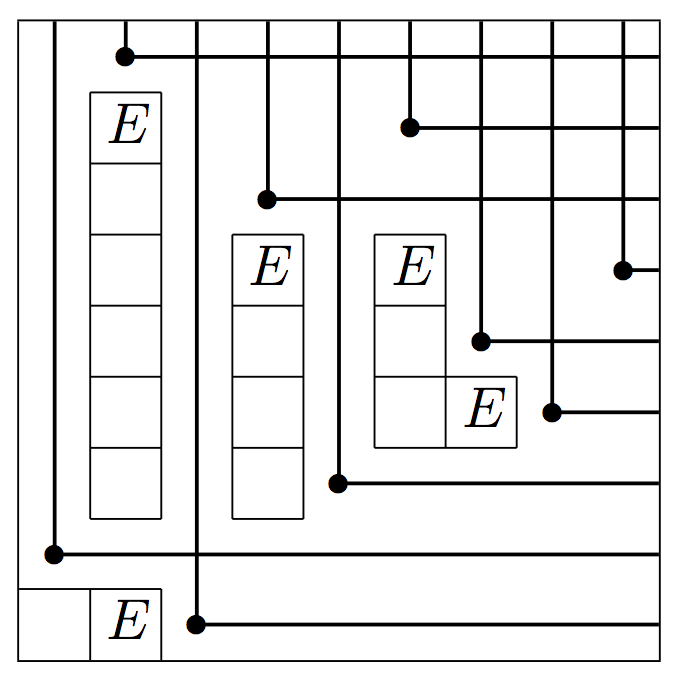 Many geometric properties of a Schubert variety can be read off from the
permutation that indexes it. The best-known example is the theorem of
Lakshmibai and Sandhya: a Schubert variety for \(GL_n\) is smooth exactly when its
permutation avoids the patterns 3412 and 4231. We study which other
properties can be described by patterns. We have characterized the Schubert
varieties that are local complete intersections by avoidance of classical
patterns, and described the Gorenstein Schubert varieties, and those defined
by inclusions, with bivincular and marked mesh patterns.
Singularities of Schubert varieties
Six conditions on a Schubert variety, from smooth to Cohen–Macaulay: what each one says geometrically, what the simplest variety that fails it looks like, and how to read it off the permutation. The page starts from how a permutation gives its variety, drawn in three dimensions, and shows any Schubert variety up close: its equations near the reference flag, its tangent space, its Schubert divisors and the cones along its singular locus. The page
Permutation classes from Schubert varieties and Schubert polynomials
A showcase of the permutation classes and sets that come from Schubert varieties and Schubert polynomials, with their combinatorial specifications: which of them a permutation belongs to, how they sit among each other, and how a specification builds a permutation, step by step. The showcase